Manifesto: The Human Datum
The enduring institutions of the coming decade will not be those that achieved the total erasure of friction through automation. Rather, they will be the ones possessed of a rare discernment: the wisdom to know exactly which human sanctuaries must remain untouched by the machine.
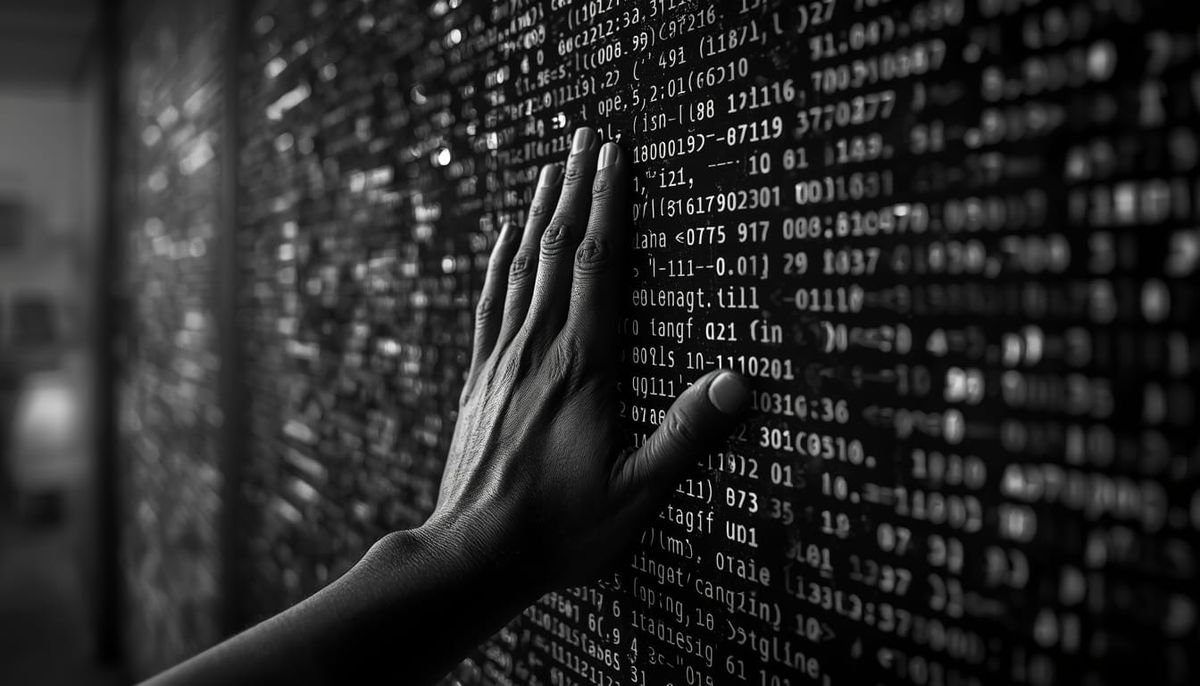
Algorithms know a person intimately. They know her routines, which song soothes her, and what she buys after a bad day. They eerily predict when she will fall in love or become ill.
There is only one problem with this person: she does not exist. She is an average—a composite from a billion selves.
She is the "user" every interface serves. She is the "consumer" who drives the economy. She is the "citizen" whose views shape policy. She is everywhere and nowhere, haunting modernity.
The Data Point Collection
We built civilization on faith. Enough data will reveal to us. Enough measurement, truth.
But the opposite is happening.
The more data we gather, the more abstract we become. The "average user" is targeted. The outlier is dismissed. Recommendation engines show what those like you want, not what you want. The self dissolves. You become a prediction.
Compare your average daily smartphone habits—quick taps and swipes—with your last visit to the beach, where you lived slowly, immersed in nature and your favorite animals. How does the brisk, repetitive interaction with your phone contrast with the unrushed, sensory individual experience at the beach? What do you feel is different between these two modes of being?
So, why did we become a prediction? This shift reflects not a failure, but a success of technology. Algorithms diminish variance, smoothing jagged experiences into something manageable and scalable. As a result, where our lives once formed distinct, unpredictable patterns—like those moments at the beach—algorithms abstract them into averages, gradually erasing nuance.
The Human Datum begins with a refusal. It refuses to accept that your grief can be averaged with a stranger's grief. It refuses to accept that "engagement" is a synonym for "meaning." It insists—stubbornly, perhaps naively—that something in the single human experience resists. Defenders of data make a strong case. Medicine using population studies saves lives. Climate models aggregating millions of data points find patterns no single observer can see. The "average" is a tool; its value depends on use. Is individual experience really so sacred? We are unreliable narrators. We misremember, rationalize, and lie to ourselves easily. Perhaps the algorithm sees us more clearly than we do.
Watch the seduction closely. The algorithm promises to liberate us from our own blindness. It offers a mirror that does not flatter.
Search For The “Why?”
There is a difference between seeing clearly and seeing truly. The algorithm sees your actions. It notes you pausing on a photograph of your father. But it does not know your reasons. It registers that you linger on the image, but is unaware that he died last spring. It does not know that the light in this is not a technical problem that sensors or models can solve. It is a category boundary. Interior life—the texture of being you now—is not data. It is where all data starts. Mistaking a map for territory is our oldest error. Now, we make it at scale.
The Human Datum does not reject data. It requires a proper place. Data describes populations, not meaning. It can optimize systems, but cannot decide which systems matter. Letting aggregates overrule individuals is not rational. It cedes judgment to a process lacking discernment.
The most successful organizations of the coming decade, I suspect, will not be the ones that automate everything. They will know exactly what not to automate. They will understand that some things—trust, craft, presence, grief, joy—are not inefficiencies to be eliminated. They are the point.
If an AI can predict your next decision with 99% accuracy, is that remaining 1% where your humanity truly resides—or is it only the margin for error that makes you unpredictable, but not meaningfully free?
With the newsletter of The Human Datum you will receive deep research and though provoking essays about:
- The Mechanics of Tomorrow: Analysis of AI, robotics, and economic shifts.
- The Architecture of Living: Essays on art, design, slow living, literature, music, architecture, fashion and mental resilience.
- The Friction Point: Where AI and the daily life of humans collide.
Subscribe to The Human Data newsletter to join the journey of new thinkers.
Jens Koester is a strategic advisor focused on the structural friction between exponential technology and the enduring patterns of human culture. Through The Human Datum, he provides the intellectual architecture and foresight necessary for leaders to navigate the AI-driven decade with clarity and intentionality.