The Rise Of Factory Robots
Customized AI agent software is the greatest opportunity for any factory to become fully automated.
12 years ago, I had the chance to visit a factory of a food supplier. I was surprised when I arrived at that factory with my team. It was certainly in the middle of nowhere and looking like a clean house with an aesthetic from 2050. When we entered, only one person greeted us, and advised us to sit down in an entrance that looked like a hospital clinic. There was no noise and there were no people.
Suddenly, a person in a white coat appeared and asked us to follow them. We went along on the tour, and it was fascinating to see that there were no employees anywhere in the entire factory. It was completely automated. Robots did all the work, filling food into packages that were automatically placed into boxes and then put onto a cart that drove electronically to a warehouse. The atmosphere was clean and quiet, with no people talking, smiling, or arguing.
We saw a lot of automation in factories in the past, especially in the automotive sector. But back in those years we also learned that robots made lots of mistakes during the production process. Human beings were certainly present around the robots, orchestrating, them, giving them the right directions.
The CEO of an automotive supplier told me that in the past, there were many problems every month with the correct adjustment of the robots and many repairs to the robots, which drove up the cost of the products to be manufactured and caused chaos throughout the factory.
The rise of AI agent software for robots is currently the greatest opportunity for any factory to automate. Daily human production tasks are delegated to AI software that is perfectly designed for the job, and robots today have a very low error rate when performing work that was previously done by humans. However, the question remains: What will happen to employees in all industries when robots take over their jobs?
What Is Physical AI?
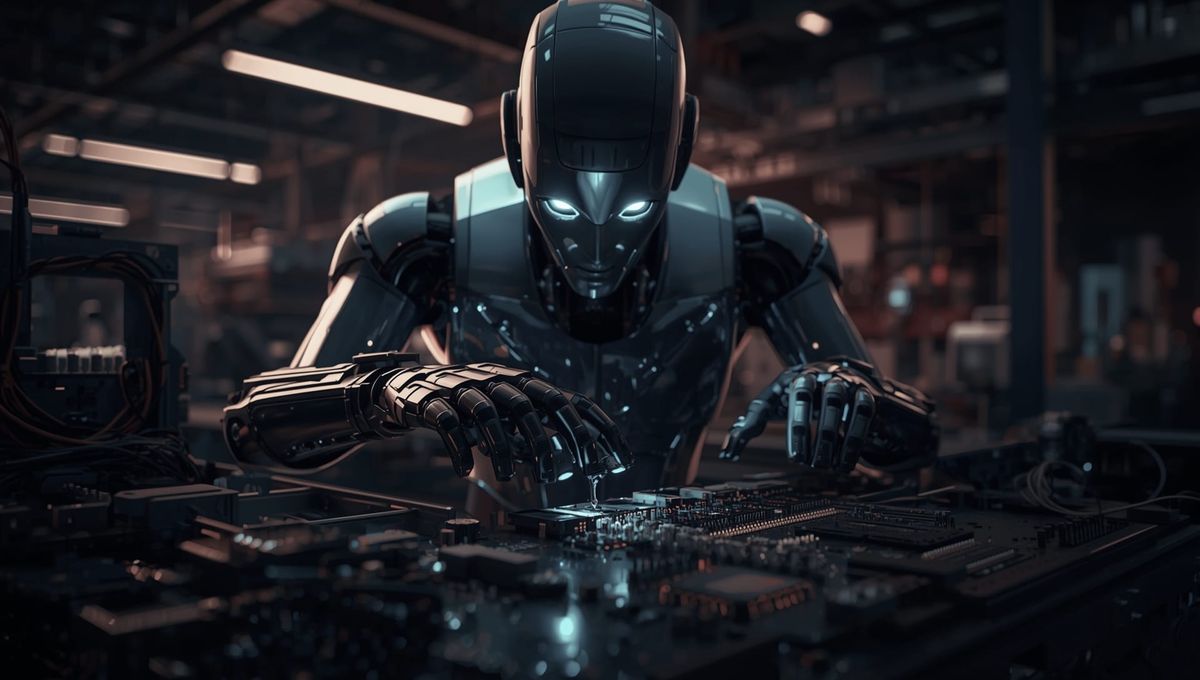
AI models are integrated into robots to optimize production processes. This software adapts to the workflow of a factory and enables robust physical behavior, even when lighting, geometry, and product variants change in the factory. Six-axis, sensor-controlled systems and sophisticated software are leading to factory processes being totally transferred to robots. And these robots are no longer used for a single task, but can be individually programmed to manufacture any product. The integrated AI agent monitors every step in the production process. As the next hardware steps are changed in the background, the software now independently dominates the daily workflow as an autonomous, self-optimizing ecosystem.
Human Supervisors
The new role of humans in these factories is primarily a supervisory function. No more endless, repetitive tasks, but rather adapting the daily software to the production of the day. The entire framework and job description of a factory worker must change in this AI-driven world. The quality of the result and the availability of labor no longer depend on human error or times when a number of exhausted factory workers are absent due to illness. Large-scale production on demand is possible; a company's entire sales, marketing, and purchasing processes must adapt to the new way of doing things, where all factory work is no longer performed by humans.
The Trust Effort
What role will employees play in factories in the future? Leaving the work to AI agents means, first of all, trusting the software developers who provide the code for the agents and, secondly, trusting the result. If a production line has to be stopped due to an incorrect movement or other faulty action by a robot, it is the task of human employees to observe and clarify what the machine is doing. This raises the question: Who is responsible for results that do not meet the company's quality standards? I was very surprised that a food company took this step toward complete automation many years ago. A number of production lines, especially in the food industry, still require human intervention due to the sensitivity of the products.
The AI Homogenization of Factories
When standard AI software is used to control hundreds of robots in production facilities, entire industries from different product and business areas will adopt the same process topologies and plant concepts. This is similar to the use of poor AI LLM results, where many publications today sound the same because all AI models use the same primary or secondary sources. Software standardization in factories leads to a uniform model, which is particularly challenging for detailed production areas. Ignoring the individual and long-standing knowledge of employees who have worked in a factory and know every detail, every recipe, and every error that can occur during production would be a fundamental mistake on the path to full automation.
The real competitive advantage lies not in the speed of physical AI implementation, but in whether a company can leverage its individual expertise and control in a production process dominated by AI.
Nineteenth‑century mechanization flooded markets with standardized goods and displaced artisans whose identity was defined to the touch of their own hands. Humans still craved tactile quality, and the reassurance that someone had cared for the object from which they derived a daily sense.
A CEO in 20206 should not present the advantages of fully automated production to his employees as an absolute virtue. Instead, he should make clear what role humans play in these new factories. He should highlight the moments when humans perform checks, fine-tuning, and finishing touches on an otherwise robot-controlled production line. Credible human interventions will be visible in the product history and even in the factory architecture.
If our factories can perceive, decide, and act with minimal human intervention, what aspects of judgment and responsibility do we not want to automate? And are we prepared to defend those boundaries when the machines outperform us on every measurable metric?
Jens Koester is a strategic advisor focused on the structural friction between exponential technology and the enduring patterns of human culture. Through The Human Datum, he provides the intellectual architecture and foresight necessary for leaders to navigate the AI-driven decade with clarity and intentionality.