The Aura Of The Original
In an age where everything can be copied infinitely and for free, we paradoxically pay more for what resists replication—not because of technological nostalgia, but because presence and singularity have become the scarcest resources.
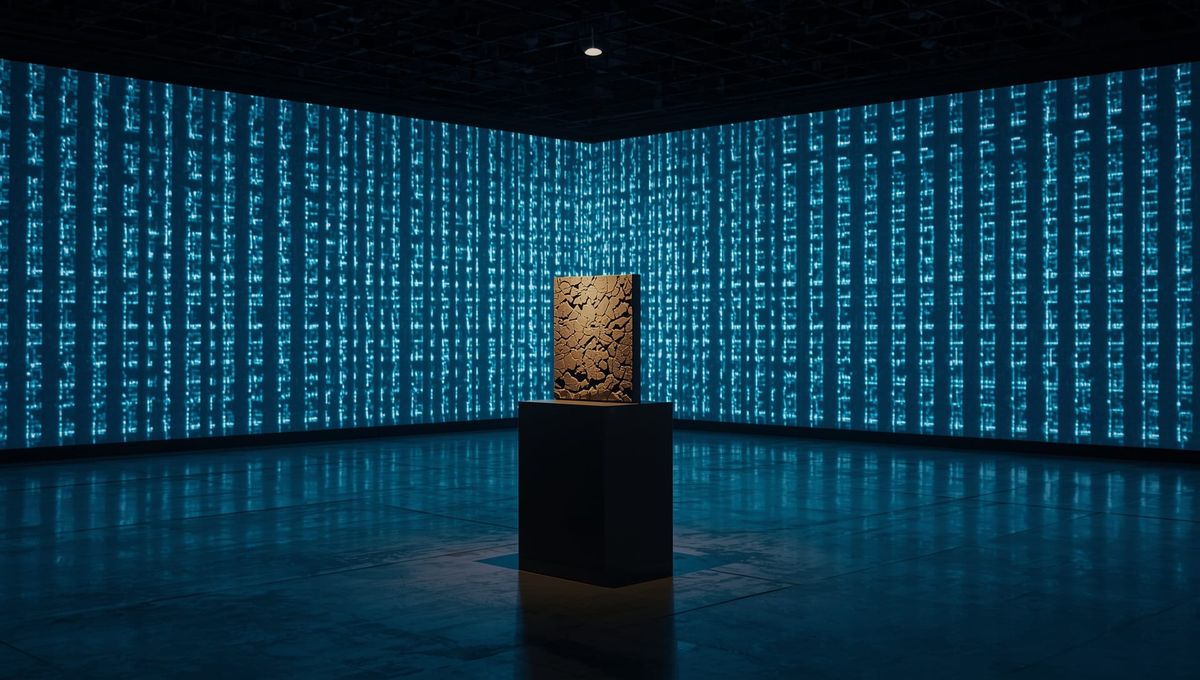
The Paradox of Abundance
In 1936, Walter Benjamin argued that mechanical reproduction destroyed art's "aura"—the ineffable sense of presence with the original object in its unique moment and place. He wrote this as photography and film democratized images, making art accessible to millions who would never see a Vermeer or visit the Sistine Chapel.
Benjamin believed technology could shatter the glass case of elite culture. But he feared that, if misused, it would create a new kind of secular ritual—one that might lead to total state control and war.
Ninety years later, we can replicate everything. Copying a digital photo a billion times costs nothing. A song exists in a million places at once. AI generates a thousand "original" paintings before lunch. We have achieved infinite copy and frictionless duplication. Economic logic says this should drive the value of images and ideas to zero.
A hand-painted canvas still commands a premium. A handshake, made in a specific room between specific people at a specific moment, still carries weight no contract can capture. The digital world has made file scarcity obsolete. Still, we pay more than ever for things that refuse to be files.
Benjamin’s Aura Was Never About Beauty
Benjamin was not arguing that reproductions look worse. He acknowledged they might offer superior viewing experiences, freed from the constraints of pilgrimage and museum queues. The aura was not in the brushstrokes themselves but in the nexus of history, place, and singular existence.
An original painting does not simply look a certain way. It includes the artist's biography and his hand on the canvas in a specific moment, under conditions that will never recur. The paint cracked in distinctive patterns due to humidity in a particular studio in 1872. This object was with Monet, with the first collector, and with a museum curator who catalogued it in 1923. Its material existence cannot be separated from its journey through time.
A reproduction, no matter how technically faithful, severs this thread. It shows the image but erases the event. You can project a Rothko onto a wall with perfect color, but you are not standing before the surface that Rothko faced. The reproduction is a ghost. It insists it is the body.
This is why, even now, the market pays for provenance. We are not purchasing pixels or pigments but a claim on history. The only truly scarce resource in an age of infinite abundance. The canvas that was in the room with the artist contains something that cannot be copied: its own unrepeatable pastness.
The Handshake as Embodied Risk
If this seems abstract, consider the handshake deal.
Here is an agreement with no blockchain, no smart contract, and no cryptographic proof. Two people meet in physical space, look each other in the eye, and clasp hands. Words are exchanged. Trust is extended. The deal is done.
I have been involved in hundreds of negotiations. From the start, I could sense whether we needed a long written framework—digitized into many PDF versions—to seal a contract with these specific buyers or partners. Or, if I simply had to look them in the eye at the end of the negotiation, shake hands, and trust each other.
Why does a handshake still work? Why do sophisticated businesspeople—people with lawyers, with insurance, with every technological tool for enforcement—still close deals this way?
The handshake embeds something contracts cannot—the weight of embodied social reality. When you shake hands, you stake your reputation not on legal code but on your physical presence in a web of relationships. Your word is in play when you commit to something or someone. The social cost of betrayal is immediate and irreversible. Courts are distant, appeals are possible, but shame is local and permanent.
Experimental research confirms what we know intuitively: a handshake changes behavior. It signals intent to cooperate. It activates fairness norms. It makes people more honest and likely to honor commitments because it taps into deeper human social architecture than any formal contract ever could.
The handshake, like the painted canvas, gets its value from what cannot be replicated: the risk of that moment. Yes, you could fail, and trust could break down. The materials—human trust, in this case—might not hold. Because the uncertainty was real, lived by specific people in a specific room, the agreement carries weight.
Digital contracts offer certainty but cost meaning. The handshake offers meaning but costs certainty. In an age of endless copies, we are discovering that certainty is oversupplied. Meaning has become undervalued.
Where Copying Stops, Value Pools
Benjamin could not have imagined our replication technology. But his insight remains: mechanical reproduction shifts the location of value. In 1936, value shifted from the ritual context of art to its political and entertainment functions. In 2026, as replication becomes instant and infinite, value again migrates toward what resists duplication.
When something can be copied at no cost, its price approaches zero. This is true for images, music, writing, and code. The digital economy has shown this in every domain. What stays valuable are the anchors: the original canvas, the handshake, the live performance, the signed edition, the verified provenance chain.
We might call this artificial scarcity: NFTs, limited editions, and museum certificates. But that misses the point. These tools only make explicit what has always been true. We do not value art or agreements solely for their information. We value them as traces of unrepeatable events—proof that someone was there, risked something, and committed something that cannot be undone.
The premium on the original is a premium on presence in a world where presence is the last thing that cannot be transmitted as data.
The Texture of Being There
Which brings us to the question Benjamin never had to ask because his world had not yet made it urgent: What happens to human meaning when everything becomes a copy?
If value flows toward what cannot be reproduced, we are creating a two-tier reality. The digital world offers endless images, music, text, and even conversation and companionship at near-zero cost. The physical realm offers a unique presence at a cost that is rising and often prohibitive. You can see a thousand Vermeers on your screen for free. But standing before the original in The Hague will cost a transatlantic flight, admission fees, and hours in line.
We are being trained to mistake abundance for access and replication for experience. We scroll past more images in a day than a 19th-century person might see in a year. Yet we call this "exposure to art." We conduct a thousand digital transactions and wonder why our trust erodes.
The aura Benjamin described was never only a property of art objects. It is a property of being itself. Every moment is singular, unrepeatable, and tied to a specific body moving through circumstances. When we offload experiences onto screens and our agreements into code, we are not just making things more efficient. We are editing out the texture that makes human life meaningful: risk, presence, and the stakes of being here rather than elsewhere.
The canvas commands a premium because it remembers it is a body touched by another body. The handshake commands a premium because it marks this moment—right now, between us—as something that can never happen again.
What Are We Really Buying When We Pay that Premium?
Perhaps we are buying proof that the difference still matters. We have not yet fully accepted the logic of digital replication, which holds that nothing needs to be singular because everything can be everywhere. Perhaps we are hedging against a future where presence itself becomes obsolete. When "Were you really there?" stops making sense, this may be our last holdout.
Benjamin worried that mechanical reproduction would destroy the ritual of art, democratizing access but draining meaning. He could not have foreseen that infinite replication might do the opposite—preserve meaning only for those who can afford to opt out of abundance.
This raises the question that should keep us awake: When everything can be copied, and only the original has value, who gets to live in the original world? What happens to the rest, wandering through endless reproductions, mistaking access for presence and confusing copies for the real thing?
As the world becomes more digital, will "analog" become the ultimate luxury good for the elite?
Jens Koester is a strategic advisor focused on the structural friction between exponential technology and the enduring patterns of human culture. Through The Human Datum, he provides the intellectual architecture and foresight necessary for leaders to navigate the AI-driven decade with clarity and intentionality.