The Resistance of the Hand
Digital tools don't just assist thinking—they transform our cognitive habits, training us into algorithmic patterns of auto-completion and passive acceptance.
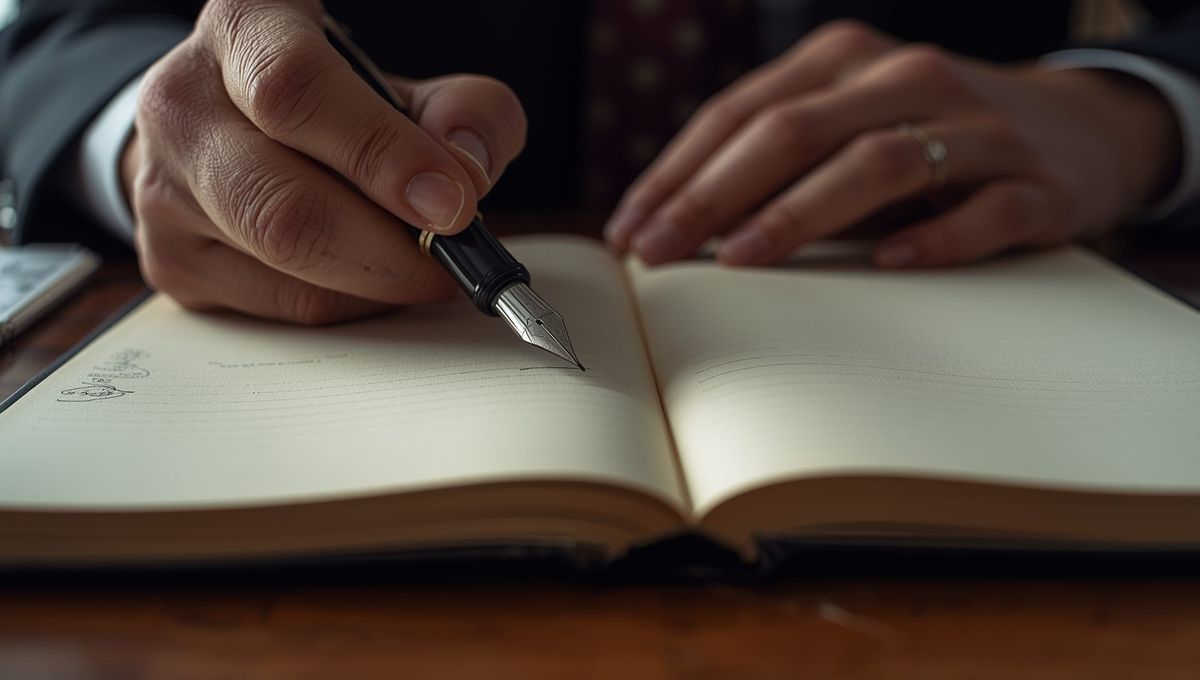
A quiet migration is underway in the upper echelons of strategic work. Consultants who once evangelized digital-first workflows are buying Moleskines. Executives who built their careers on velocity are slowing down to the speed of ink. The fountain pen—that relic of a pre-digital age—is appearing in boardrooms again, not as an affectation, but as a tool.
What is being escaped is not technology itself, but a form of thinking dictated by algorithms and digital tools—a pattern where technology finishes our thoughts for us, often before deeper, unique reasoning occurs. The resistance to these patterns is a deliberate reclaiming of independent thought.
Strategists are not rejecting technology wholesale; they are rejecting the subtle surrender of mental autonomy to digital tools that increasingly shape our thinking, often without our full awareness or consent.
The Neural Case
Neuroscience suggests a distinction between handwriting and typing: when we write by hand, the brain appears to recruit a broader network, including areas involved in movement, vision, language, and memory. This is often described as a more embodied engagement with thought.
Typing, by contrast, is a lighter touch and seems to be efficient. But efficiency is not always the goal of thought. When we need originality, to hold conflicting ideas in mind and map their relationships, friction becomes a benefit.
The hand moves more slowly than keyboard typing, which forces compression, selection, and paraphrasing. This slowness creates space for the mind to evaluate and synthesize. The strategist using a pen is building a universe of thought, expressed in a unique script only he can produce.
Then there is the question of what happens between keystrokes. Every time we pause to type, the digital environment fills the silence with suggestions. Search bars, auto-complete, or AI assistants offer next-word predictions. These tools train our brains to offload thinking. Why think deeply if the algorithm can think shallowly but instantly?
The Auto-Complete Trap
Digital tools are today essential as digital assistants. The daily flood of hundreds of emails, texts, and social media comments can overwhelm us. Digital writing tools push bottom-up, stimulus-driven processing rather than the more deliberate, top-down thinking that strategy requires.
This auto-complete loop is convenient, but it outsources thinking and, over time, weakens originality. Accepting algorithmic suggestions trains us to follow common answers and familiar phrasing.
Strategists flee to paper because the blank page neither predicts nor suggests. It allows thoughts to be formed in a personal style, enabling the emergence of an idiosyncratic inner voice not shaped by algorithmic conformity.
The Tactile Anchor
There is also the matter of the body. A fountain pen on quality paper creates a sensory-rich experience—the resistance of the nib, the flow of ink, the texture of the page. This tactile feedback does something the screen cannot: it anchors attention in physical space.
The digital environment is designed for scrolling, for endless lateral movement, for the ability to revise and delete with zero cost. This has its virtues, but it also creates a problem: nothing is ever final. Every thought is provisional. Every sentence can be endlessly tweaked. The result is a kind of cognitive drift, a refusal to commit.
The pen, by contrast, demands commitment. You cannot easily delete or scroll back through endless drafts. Each page is limited—a finite cognitive workspace. This constraint forces the writer to stay with an idea long enough to find its meaning and slows the process to a human pace.
Strategy as Spatial Thinking
Strategic thinking is not linear—it is spatial. It means holding many possibilities in mind at once. You map their relationships, draw arrows between concepts, and sketch diagrams in the margins. The page allows for this in ways the screen cannot.
By avoiding algorithmic suggestion, the strategist preserves a non-linear, associative, and sometimes irrational process that fosters true insight. In an AI-driven world, cognitive tools should sometimes resist, not accelerate.
In an age where attention is colonized by algorithms, where thought itself is increasingly mediated by interfaces designed to predict and pre-shape it, the act of writing by hand is a way of saying, "My thoughts are my own."
The pen is slow, inefficient, and does not scale, but it is yours. And in an age where so much of our cognitive life is outsourced, optimized, and algorithmically shaped, that might be the most strategic choice of all.
If we cannot think a thought without the algorithm suggesting it first, are we still thinking—or are we simply choosing from a menu?
Jens Koester is a strategic advisor focused on the structural friction between exponential technology and the enduring patterns of human culture. Through The Human Datum, he provides the intellectual architecture and foresight necessary for leaders to navigate the AI-driven decade with clarity and intentionality.