The Strategic Value Of Silence
Monastic architectural traditions were optimized for a tightly integrated ecosystem of silence, ritual, and communal stability rather than for loud group meetings.
The open-plan office was never designed for thinking. It was designed for surveillance—for the managerial gaze to sweep unimpeded across rows of productive bodies. That we called this “collaboration” was the cruelest euphemism of late capitalism.
The Monastery’s Revenge
We built cathedrals to noise. Glass and steel and the hum of a hundred keyboards. We thought that we needed a lot of energy together to be productive and innovative as a team. We measured success in density—bodies per square foot, conversations overheard, “serendipitous collisions.”
The monk in his cell, the scholar in her study, the writer staring at a blank wall—they knew something we chose to forget. Attention is not infinitely divisible. Every interruption is a theft. Every WhatsApp message or question from a colleague disrupts our work.
We optimized for presence when we should have optimized for depth.
The Cognitive Tax of the Open Floor
Here is what the research tells us, stripped of corporate euphemism:
- Working memory degrades by 14–22% in open environments compared to enclosed offices—not from “distraction” as a vague concept, but from the specific phenomenon of intelligible irrelevant speech. The brain cannot help but parse language it can hear, even when that language has nothing to do with the task at hand.
- Stress hormones rise. Mood worsens by a quarter. Fatigue accumulates. People report “adaptation,” but their performance metrics tell a different story—they have merely grown accustomed to operating at diminished capacity.
- The tasks most affected are precisely the ones that matter most: strategy, analysis, synthesis, writing—anything requiring the sustained manipulation of complex information in working memory.
We built environments that systematically tax the cognitive operations we claim to value most.
The Case for Noise (And Why It’s Collapsing)
The trading floor wasn’t irrational. When work consisted of rapid-fire transactions, when speed mattered more than depth, when the value was in the volume—then yes, the open bullpen made a kind of brutal sense. Information needed to flow fast. Coordination needed to happen in real-time. The occasional brilliant insight overheard across desks was worth the ambient chaos.
And there was the economic argument: density is cheap. Private offices are expensive. Square footage is finite. The open plan lets companies pack more workers into less space and call it “democratization.”
But here is what has changed: execution is becoming cheap.
AI agents will handle the rapid-fire transactions. Algorithms will coordinate at speeds no human bullpen can match. The trades will execute themselves. The emails will draft themselves. The spreadsheets will populate themselves.
Benedictine and Cistercian monastic architectural traditions were optimized for a tightly integrated ecosystem of silence, ritual, and communal stability rather than for loud group meetings.
What remains—what only humans can provide—is judgment. The capacity to weigh incommensurable values. The wisdom to know what questions to ask at the right moment.
Imagine yourself in a decision process with your team. You need time, the right resources, and most of all, you need silence. Your judgment requires conditions that the open plan cannot provide.
The Architecture of Judgment
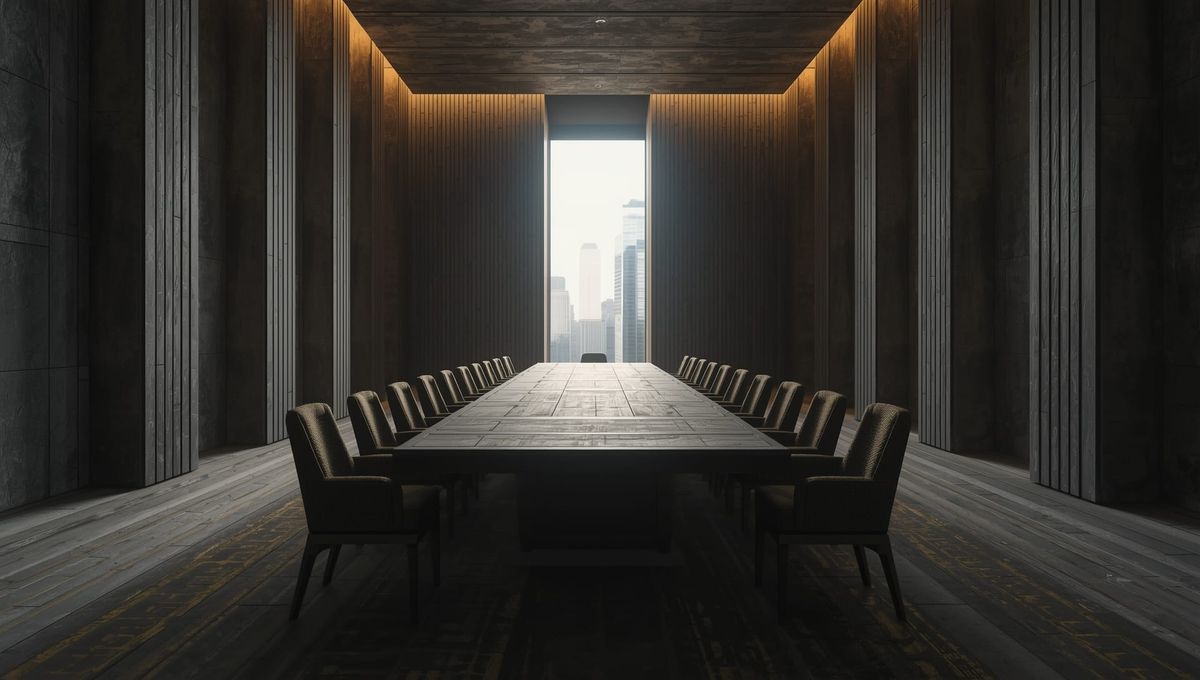
The boardroom of 2030 will look like a monastery because it will serve the same function—the protection of contemplative work from the world's noise.
What the design trajectory reveals:
Quiet zones are no longer perks. They are infrastructure. Acoustic pods, sound-zoned environments, high-backed seating, absorbent textiles—these are not amenities.
They are the new tools for the future of work, driven by AI and the rhythms of data centers.
The coming workspace will be stratified by consequence. The open floor persists for low-stakes coordination—the ambient work that machines haven’t yet absorbed. But the rooms where leveraged decisions happen—where a single meeting can move billions, where AI-assisted scenarios are weighed, where risk is genuinely contemplated—will be cloistered.
Small. Highly insulated. Low-reverberation materials. Controlled light and temperature. Strictly managed sound ingress. The only noises will be deliberate: a voice, a pen, perhaps a brief from the machine.
The perception of every sound will change, designed not to compete for the executive’s scarce attention but to support it.
Imagine it: walls that absorb rather than reflect. Silence deep enough to hear your own thinking. Technology everywhere—but invisible, inaudible, subservient.
The monastery was an architectural design for communion with the transcendent. The boardroom of 2030 will be an architecture designed for communion with complexity.
The Uncomfortable Question
Here is what troubles me:
We are building sanctuaries for thought—but only for those who can afford them. The quiet room, the acoustic pod, the monastery-boardroom… these will be reserved for the few whose judgment is deemed valuable enough to protect. The rest will remain in the noise. Their cognitive capacity will continue to hemorrhage into the ambient chaos of the open floor.
If silence is necessary for serious thought, and serious thought is what distinguishes human contribution from machine output, then silence is becoming a class privilege.
The monastery was open to anyone who took vows. The corporate cloister will be open only to those who sit at the top of the leverage stack.
So I leave you with this:
In a world where attention is the last scarce resource, who will be permitted to think deeply—and who will be condemned to the cognitive poverty of perpetual interruption?
Jens Koester is a strategic advisor focused on the structural friction between exponential technology and the enduring patterns of human culture. Through The Human Datum, he provides the intellectual architecture and foresight necessary for leaders to navigate the AI-driven decade with clarity and intentionality.