What Brutalist Architecture Knows About Resilience
In an economy addicted to the cosmetic surgery of “disruption”—the Brutalist building asks: What if honesty were a competitive advantage?
The Ugly Survivor
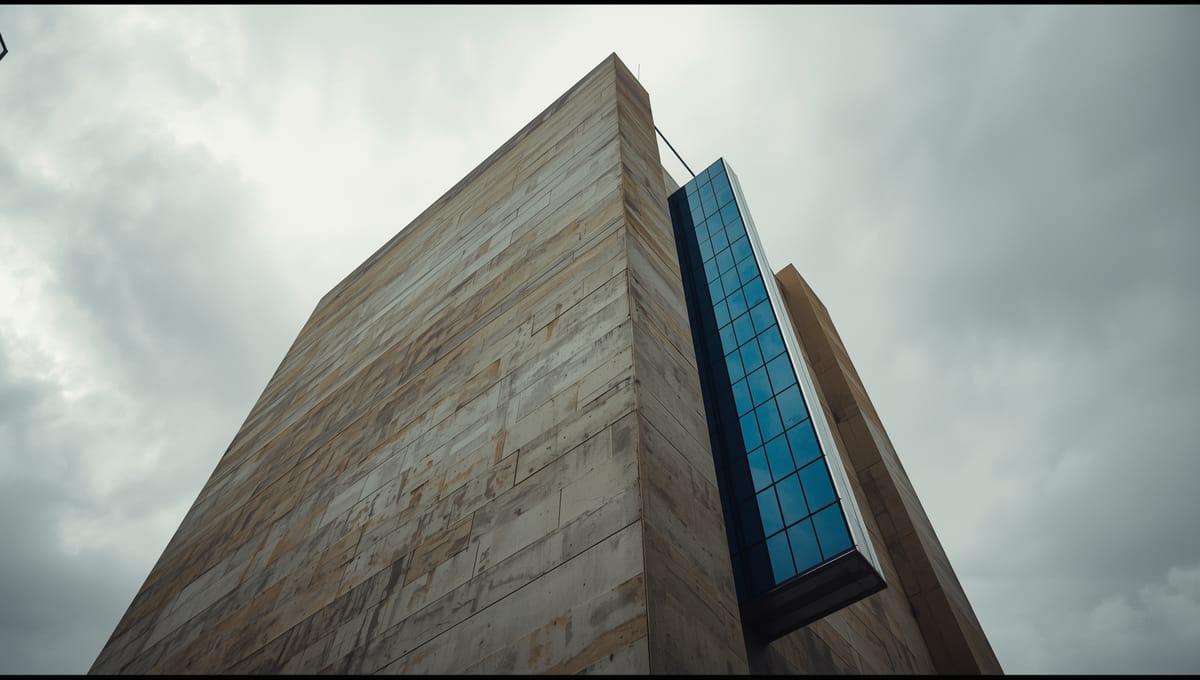
There is a municipal building in your city—or one very like it—that everyone agrees is hideous. It squats on its block like a rebuke. The concrete is stained. The windows are too small or too large in all the wrong places. Local newspapers run periodic features about whether to demolish it. Architects shudder. Instagram influencers avoid its shadow.
It has outlived three recessions, two “revitalization” projects, and a half-dozen glass-and-steel towers that were supposed to replace it. Those towers now sit half-empty or have been converted into something their designers never intended. The brutalist hulk remains, still housing the same civic functions it was built for sixty years ago.
We are taught to believe that beauty sells, that sleekness wins, that the market rewards the aesthetically pleasing. But Brutalism presents an uncomfortable counterexample: sometimes the survivors are ugly. Sometimes they survive because they are ugly—or rather, because they refused to spend their resources on being anything other than exactly what they needed to be.
The Economy of Exposed Structure
Brutalism was born from scarcity. Post-war Europe needed to rebuild entire cities with depleted treasuries and decimated workforces. There was no budget for marble facades or decorative flourishes. Architects like Alison and Peter Smithson, Ernő Goldfinger, and the disciples of Le Corbusier made a virtue of this necessity: béton brut—raw concrete—became not just a material choice but a philosophical stance.
The logic was simple and brutal: expose the structure. Show the bones. Let the building announce, without apology, exactly what it is made of and exactly what it is for.
This is not merely an aesthetic preference. It is an economic strategy with profound implications:
Lower complexity cost. When you hide structure behind decoration, you create layers—each of which must be built, maintained, and eventually replaced. Exposed systems have fewer failure points. The maintenance man can see what is broken.
Transparent performance. A building that shows its skeleton cannot easily lie about its condition. Cracks are visible. Stresses are legible. The same is true of a business model that does not hide its unit economics behind layers of creative accounting and “adjusted EBITDA.”
Resistance to fashion. Ornament is always of its moment. The harvest-gold appliances of the 1970s, the Memphis design of the 1980s, the “millennial pink” of the 2010s—all of these become dated within a decade. But a load-bearing wall does not go out of style, because it was never in style. It simply is.
The Brutalist building, in Europe or in the United States in this reading, is not a failure of imagination but a discipline of attention. It asks: What is essential? And then it builds only that.
The Seduction of the Ornamental
But surely, one objects, people do not want to live and work in concrete bunkers. Surely there is value in beauty, in delight, in the human need for spaces that inspire rather than merely function.
This objection is not wrong. It points to a real limitation of Brutalism: many of these buildings became, in practice, alienating. Housing projects like Pruitt-Igoe in St. Louis or Robin Hood Gardens in London became synonymous with urban decay. The concrete that was supposed to be “honest” became, to residents, merely cold. The scale that was meant to be efficient became, to human beings who had to navigate it daily, crushing.
And in business, the analogy has its own dangers. A company stripped to pure function—no brand, no story, no emotional connection—may be efficient, but is it lovable? Is it even memorable? The Aldi model works, but could it ever inspire the devotion of an Apple? Does radical legibility leave room for the meaning that makes people choose you over a spreadsheet-equivalent competitor?
This is the trap that awaits the too-literal application of Brutalist logic: mistaking austerity for honesty, confusing the elimination of ornament with the elimination of humanity.
Honest Structure, Human Scale
The resolution lies in a distinction that Brutalism’s critics often miss and its champions often forget: honesty of structure is not the same as hostility to human experience.
The best Brutalist buildings—Tadao Ando’s Church of the Light, Louis Kahn’s Salk Institute, Denys Lasdun’s National Theatre—achieve something remarkable. They expose their concrete bones, yes. They refuse decorative dishonesty. But they also pay ferocious attention to light, to proportion, to the path a human body takes through space. They are honest and humane. They achieve what we might call Human Scale Brutalism: the discipline of essential structure combined with the wisdom of the Human Datum.
Translated into business terms, this synthesis suggests a model that is:
Structurally legible. Costs, value propositions, and operations are visible to customers, to employees, to investors. There is no financial engineering that obscures what the company actually does or how it actually makes money.
Functionally essential. The organization focuses on a core job-to-be-done with rigor, rather than diversifying into adjacencies that dilute attention and add complexity.
Humanly resonant. Within that essential structure, there is careful attention to the texture of experience—how it feels to use the product, to work at the company, to interact with its people. The austerity is in the bones, not in the soul.
Firms like the German discount chain ALDI deliberately simplify their assortment, store layout, and operations to strip out nonessential costs. That constraint is their strategic advantage, not a limitation. Customers know exactly which products are available at which stores and which prices ALDI is offering in a given week or month. Scarcity is a strategy here, and it attracts more customers; the psychological effect of missing out leads to long lines in front of ALDI stores before opening hours.
This business model asks: What ornament serves human experience, and what ornament merely serves our vanity as builders? What is the decoration that helps people feel at home in the structure, and what is the decoration that just makes us feel clever?
What Are You Hiding?
We live in an age of unprecedented ornamentation. Not in architecture—there, the glass curtain wall has its own sterile honesty—but in business, in technology, in the systems that organize our economic lives.
Every startup wraps its basic function in layers of branding narrative and pitch-deck poetry. Every corporation hides its actual operations behind ESG reports and mission statements that have been workshopped to semantic emptiness. Every tech platform conceals its real product—your attention, your data, your behavioral patterns—behind a facade of “connecting people” or “organizing the world’s information.”
We have become masters of the decorative.
Brutalism’s enduring challenge is not that we should all build in concrete. It is that we should ask, of every system we create or inhabit: What would this look like with the facade removed? What is the structure actually doing? Who is it actually serving? And what are we so afraid to expose?
The buildings that survive, like the businesses, are often the ones that could answer those questions without embarrassment. They may not be beautiful by the standards of their moment. They may lack the charm that wins magazine covers and funding rounds. But they stand—because what they are made of is aligned with what they are for.
In a world of polished, AI-generated facades, do you have the courage to show the rough concrete of your business reality?
Jens Koester is a strategic advisor focused on the structural friction between exponential technology and the enduring patterns of human culture. Through The Human Datum, he provides the intellectual architecture and foresight necessary for leaders to navigate the AI-driven decade with clarity and intentionality.